
Abstract
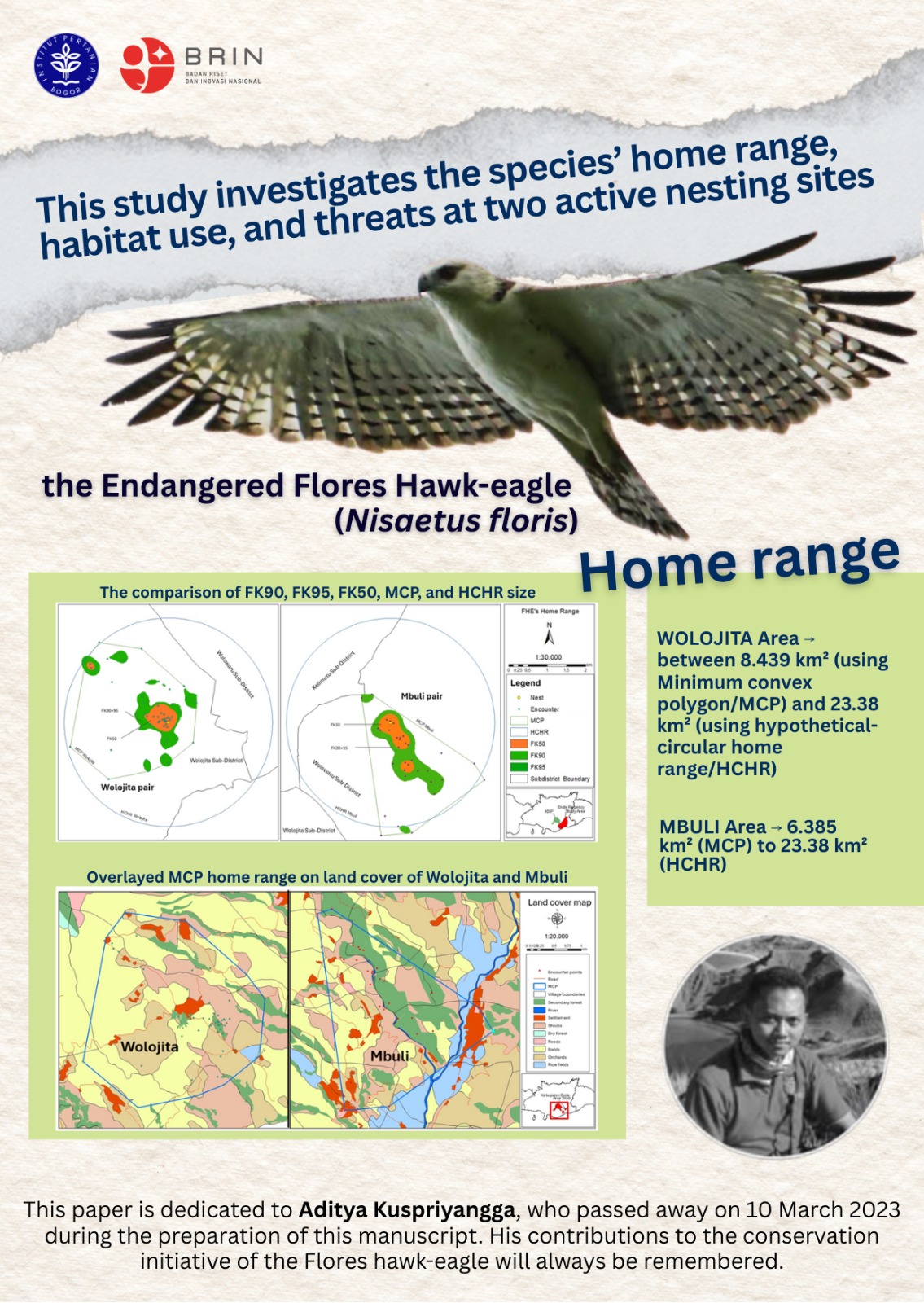
The Flores hawk-eagle (Nisaetus floris) is an endangered raptor endemic to the Lesser Sunda region and remains understudied, hindering effective conservation planning. This study investigates the species’ home range, habitat use, and threats at two active nesting sites in Ende District, Flores Island. Home range estimates varied between 8.439 km2 (using minimum convex polygon/MCP) and 23.38 km2 (using hypothetical-circular home range/HCHR) in Wolojita and from 6.385 km2 (MCP) to 23.38 km2 (HCHR) in Mbuli. Intensive use areas were relatively small, measuring 0.449 km2 in Wolojita and 0.494 km2 in Mbuli. Habitat use analysis revealed that in Wolojita, the eagles favored secondary forests, settlements, and shrublands, while in Mbuli, they primarily utilized grasslands and secondary forests, actively avoiding agricultural lands, rice fields, and areas near sulfuric rivers. Secondary forests appear to provide essential resources such as nesting trees and prey availability. However, competition with other raptor species, coupled with anthropogenic threats such as habitat degradation, land-use change, and persecution driven by livestock predation, poses significant risks to the species’ survival. Conservation should focus on preserving secondary forests, promoting sustainable land-use practices, and mitigating human-wildlife conflict to ensure the long-term viability of the population.
Keywords: Nisaetus floris, home range, habitat use, threat, conservation
Source:
Kuspriyangga A., Mulyani YA., Syartinilia, Oki H. Home Range and Habitat Use of the Endangered Flores Hawk-eagle (Nisaetus floris) in Ende, Flores, East Nusa Tenggara. Jurnal Manajemen Hutan Tropika, 31(2), 133. https://doi.org/10.7226/jtfm.31.2.133 (2025)